Website Maintenance Plans for Small Business
"Maintenance" gets used loosely, and two vendors can sell you a "website maintenance plan" for wildly different prices and mean completely different things by it. Here's what a real plan actually includes, what it typically costs, what happens if you skip it, and how DesertCRM's care plan compares — built and run remotely for small businesses nationwide, from our home base in the Phoenix metro.
Short answer: a real website maintenance plan covers security patching on a schedule, automated and tested backups, uptime monitoring with alerts, SSL renewal, performance tuning, broken-link and form checks, content edits, and a monthly report. In the general market that typically runs $30-300/month depending on what's actually included — a lot of cheap plans are just hosting with a different label. DesertCRM's care plan starts at $149/month and includes all of it, with a 12-month minimum, then month-to-month.
No plan vs. DIY hosting vs. an agency retainer vs. DesertCRM
Website maintenance is one of the vaguest line items a small business ever buys. Here's how the common options — including doing it yourself — actually compare.
| Option | Typical cost | What's actually covered | The catch |
|---|---|---|---|
| No plan at all | $0/month | Nothing — the site runs until something breaks | An unpatched CMS becomes a security hole nobody is watching |
| DIY-maintain it yourself | $5-30/month | Server uptime only, on a shared host | Patching, backups, monitoring, and edits are all on you and your calendar |
| Typical agency retainer | $100-300+/month | Varies widely — often unstated exclusions on edits | "Unlimited edits" frequently excludes anything past a quick text swap |
| DesertCRM care plan | From $149/month | Hosting, SSL, patching, tested backups, monitoring, edits, reporting | 12-month minimum, everything included from day one |
Not sure which route fits your situation, or starting from scratch? See the web design overview or the full website cost guide →
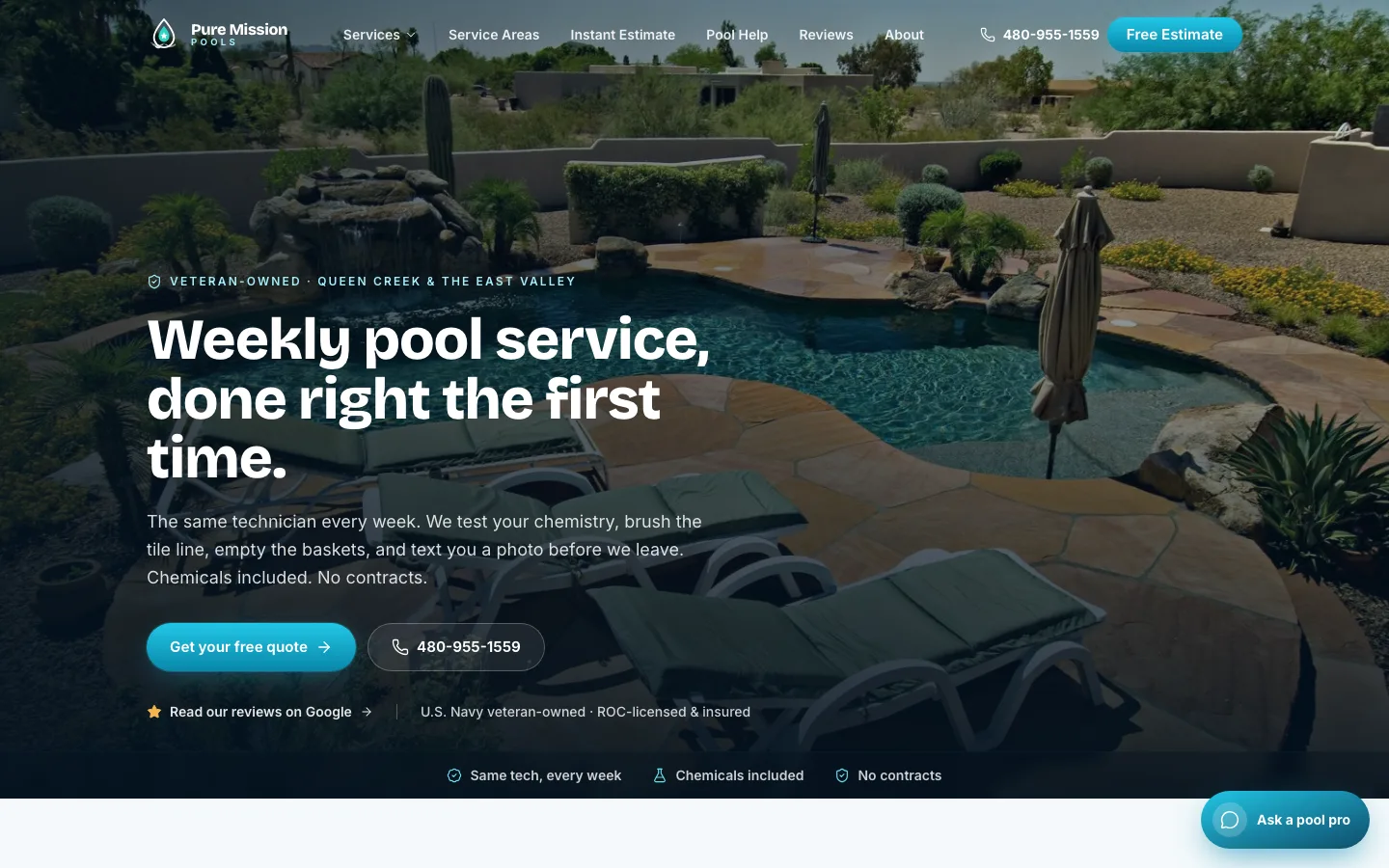
A real client, run on this exact care plan
Pure Mission Pools is a Phoenix-metro pool service company DesertCRM built and still runs on the care plan model: managed hosting, security patching, and content edits across a ~42-page city-by-service local-SEO footprint, three live AI tools, and lead forms wired to the owner's inbox — all covered under one monthly fee.
Why skipping maintenance is more dangerous than it looks
A website isn't a static object you build once and leave alone — it runs on software, and every piece of that stack changes over time. Skipping maintenance rarely causes an immediate, visible problem, which is exactly what makes it dangerous. An outdated CMS or plugin becomes a security hole that stays exploitable for as long as the update goes unapplied, and compromised small business sites get used to inject spam links or host malware, often without the owner noticing until Google flags the site. Contact and quote forms depend on a chain of moving parts — the form plugin, the email service, spam filtering — and any link in that chain can quietly break with no error message, silently costing leads for weeks. An expired SSL certificate is the one failure that's instant and visible: browsers show a hard security warning before a visitor can even reach the site, and most people leave rather than click through. If a site is already past a quick patch — hacked, hopelessly outdated, or effectively down — a 24-hour rebuild gets something live fast while a real maintenance plan gets set up behind it.
What real maintenance covers
Here's what should actually be in a website maintenance plan, and why each item matters:
- Security patching — CMS core and plugin updates applied on a defined schedule, not "eventually," so known vulnerabilities close before they get exploited.
- Backups, and tested restores — automated backups are table stakes; a backup nobody has actually restored from is a backup you're hoping works.
- Uptime monitoring — automated alerts the moment the site goes down, rather than waiting for a customer to mention it.
- SSL renewal — tracked and renewed before expiration so a certificate lapse never becomes the visitor's problem.
- Performance tuning — periodic checks for bloated images, slow plugins, and anything dragging load times down.
- Broken-link and form checks — confirming the paths visitors actually take through the site still work, and that lead forms are still delivering.
- Content edits — hours, pricing, staff photos, a new service, handled as routine, not billed as a new project every time.
- Monthly reporting — a plain-English summary of uptime, what was patched, and what changed, sent proactively instead of buried in a dashboard nobody opens.
What cheap "maintenance" plans quietly exclude
Watch for "backups included" with no mention of restores, hosting-only plans with no actual security patching, "unlimited edits" with unstated exclusions for anything past a simple text swap, no uptime monitoring at all, or a monthly traffic email standing in for a real report. The question that cuts through the vagueness: if your contact form stopped emailing you tomorrow, how would either of us find out, and how fast would it get fixed? A vendor with real maintenance in place has a specific answer.
DIY vs. a real plan
Doing it yourself isn't free — it just moves the cost from a monthly invoice to your own hours. A DIY setup on a $5-30/month host still leaves patching, backup testing, uptime monitoring, and every content edit on your plate, on top of running the business the site is supposed to support. That's a reasonable trade for a hobby site with nothing on the line. It's a much worse trade once the site is how customers actually find and call you, and every hour spent patching a plugin is an hour not spent on the business itself.
What DesertCRM's website maintenance plans include
One plan covers nearly every small business site. Larger or higher-traffic sites are scoped and quoted after a short call — never guessed at or sprung on you later.
The plan almost every small business site runs on — everything a real maintenance plan should include, in one monthly fee.
- Managed hosting + SSL + domain management
- Security patching + automated, tested backups
- Uptime monitoring with alerts
- Unlimited-within-reason content edits
- Monthly report + same-day weekday response
- 12-month minimum, then month-to-month
For larger sites — more pages, city-by-service local-SEO landing pages, heavier traffic, or an existing site we're taking over maintenance on.
- Everything in the care plan
- Scoped for site size and complexity
- Works with existing sites, including WordPress
- Fixed monthly price confirmed before anything starts
Full detail on every item in the care plan — including how it compares to a $650 starter build — is on the pricing and care plan page.
Website maintenance plan questions, answered straight
Want a plan with nothing left to guess at?
Tell us about your current site — or the one you're about to build — and we'll tell you honestly what maintenance it actually needs, before you commit to anything. Delivery is remote, so wherever your business is, we can run it.
Care plan from $149/month · 12-month minimum · senior-led delivery, start to finish